FUE Hair Transplant in Lahore: How the Procedure Works From Extraction to Implantation
Before progressing to advanced baldness, hair loss frequently begins with mild temple or crown thinning. Surgical restoration remains the only permanent solution for bald zones where follicles have closed. Follicular Unit Extraction (FUE) is the modern gold standard for surgical hair restoration. When researching an FUE hair transplant in Lahore, knowing the precise clinical steps of this process will enable you to make an informed decision.
What is Follicular Unit Extraction?
The Science Behind the FUE Procedure
Individual follicular units are extracted directly from the permanent donor zone—usually the back and sides of the scalp—using a specialized microsurgical punch. Depending on the patient scalp characteristics, skilled surgeons utilize Manual FUE with a hand-controlled manual punch for delicate tactile extraction, or Motorized FUE to efficiently harvest higher graft numbers. Both methods secure one to four healthy hair roots per graft while maintaining the structural integrity of the donor scalp, avoiding the long linear incisions used in older strip techniques.
Why Patients Prefer FUE Over Older Methods
Traditional strip harvesting resulted in linear scars, scalp tightness, and longer healing times. Modern FUE eliminates those drawbacks. Tiny circular extraction micro-openings heal within days, offering minimal discomfort after surgery, no linear scarring, and a short recovery timeline.
The FUE Procedure Timeline: What to Expect
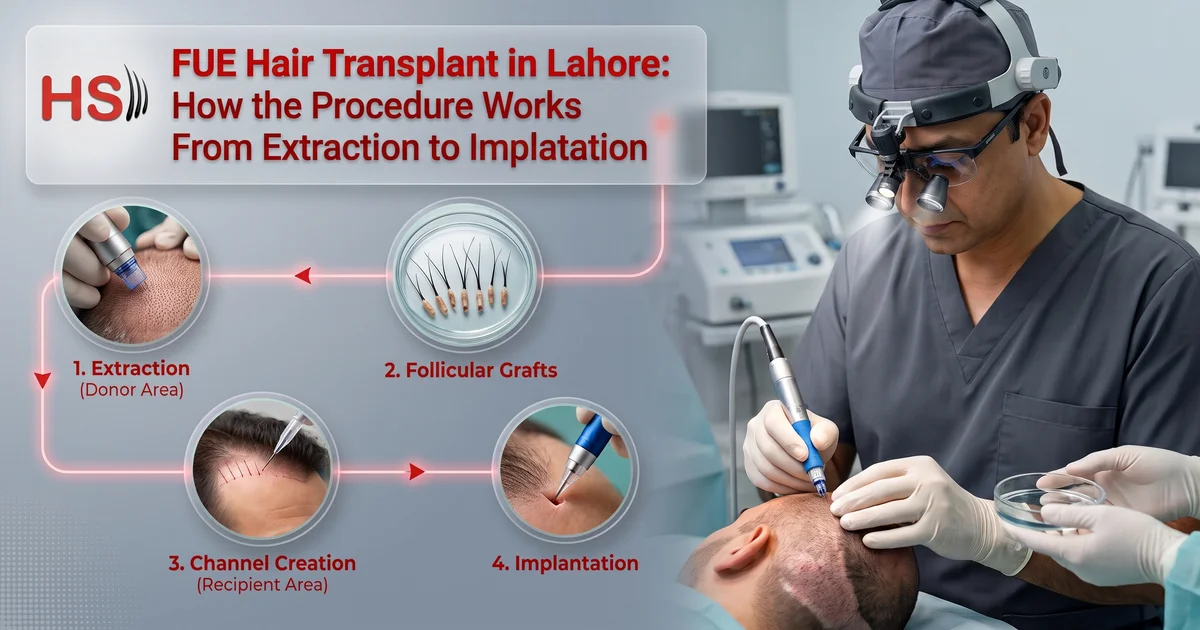
On the day of your procedure, the session adheres to four specific clinical stages:
| Procedure Stage | Action Performed | The Medical Purpose |
|---|---|---|
| 1. Local Anesthesia | Numbing donor and recipient regions with needle-free comfort anesthesia | Delivers a comfortable, calm experience during graft extraction and placement. |
| 2. Graft Extraction | Harvesting individual follicular units | Secures intact, healthy roots from the safe donor zone using micro-punches. |
| 3. Channel Creation | Opening recipient micro-incisions with Sapphire blades or DHI pens | Determines precise placement angles, direction, and density across thinning regions. |
| 4. Implantation | Inserting harvested grafts | Carefully seats individual follicles into prepared sites for continuous future growth. |
The Art of Designing a Natural Hairline
Angles, Direction, and Density
Proficiency in graft extraction is only one part of a successful restoration. Achieving a natural hairline design is the true artistic benchmark. Single-hair grafts are positioned along the soft frontal border—including specialized contours such as a widows peak or Chinese and Asian hair angle calibration—with multi-hair grafts placed further back toward the mid-scalp and crown. Each channel replicates the acute forward angle and natural direction of native hair.
FUE Recovery and Post-Op Care
The First 7 Days After Surgery
During the early stages of vascular bonding, newly inserted roots are protected by careful post-operative care. During the first 48 hours, tiny scabs naturally form around graft sites. To reduce forehead swelling, patients sleep with their head elevated and follow gentle hair washing protocols using mild clinical foam and saline sprays.
Choosing a Trusted FUE Hair Transplant Clinic in Lahore
Technical proficiency and transparent 1-day and 2-day session planning are essential when selecting an FUE center in Lahore. Hair Skill Clinic in Gulberg III, led by Dr. Mansoor Ahmad (PMDC Reg. No. 1535-P), provides custom hairline planning and surgeon-led care designed for lasting confidence.