Failed Hair Transplant Repair in Lahore: How Certified Surgeons Fix Botched Results
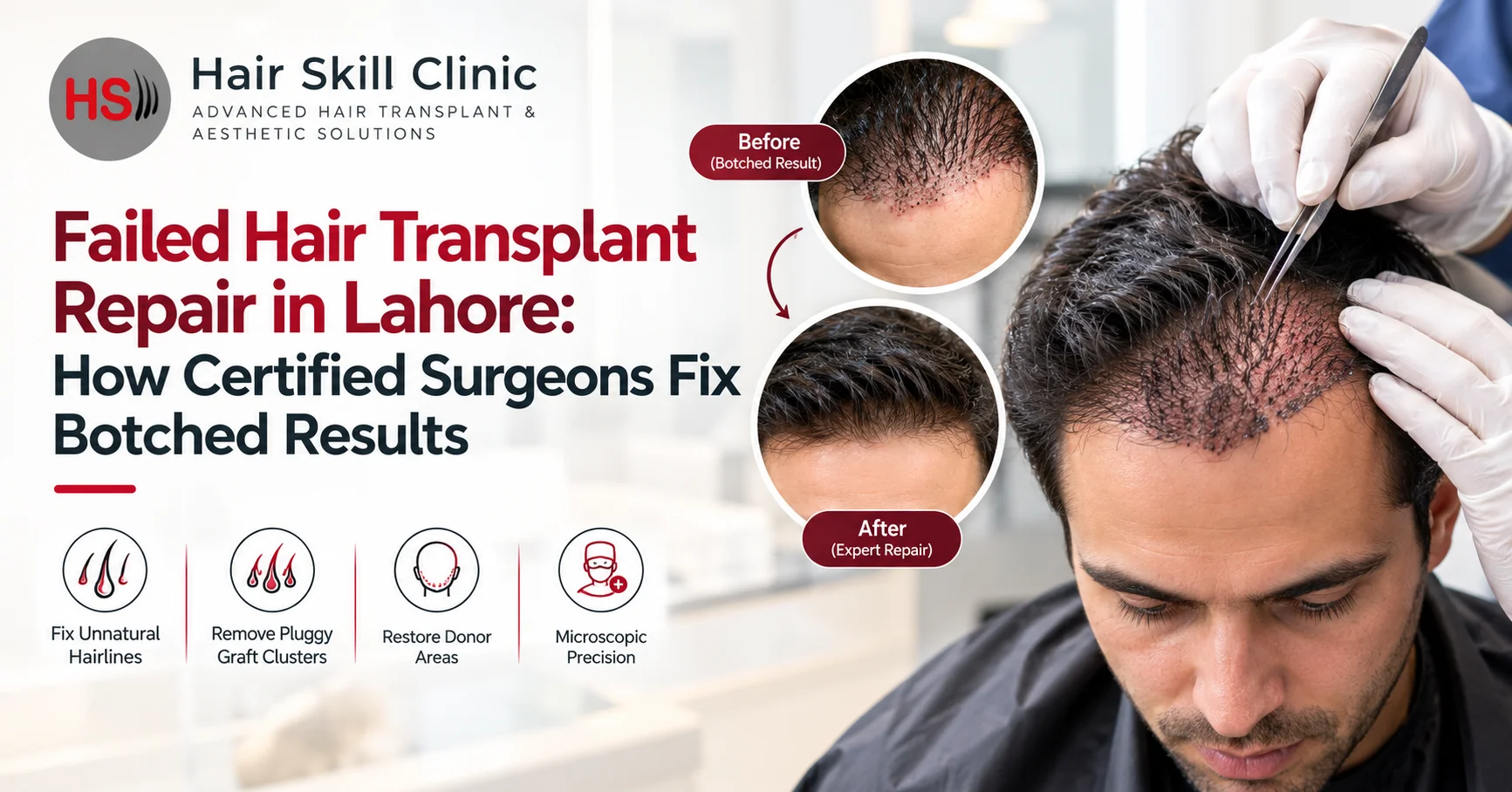
Leaving an unregulated technician clinic with visible scarring, harsh angles, or patchy growth is deeply distressing. Many patients feel forced to hide under caps after being misled by bargain advertisements. A poorly executed procedure is never the fault of the patient—and modern reconstructive techniques can significantly improve your appearance. For specialized hair transplant repair in Lahore, Dr. Mansoor Ahmad (PMDC Reg. No. 1535-P) at Hair Skill Clinic in Gulberg III performs meticulous corrective restoration to rebuild natural hairlines and camouflage scars.
Common Signs of a Botched Hair Transplant
Identifying the exact surgical errors allows our medical team to design an accurate revision plan:
- Pluggy Doll-Hair Look: Large multi-hair follicular bundles mistakenly implanted along the very front edge of the hairline instead of fine single hairs.
- Unnatural Angles & Low/Straight Placement: Grafts inserted at steep 90-degree angles or in a harsh geometric line that does not suit facial anatomy.
- Over-Harvested Donor Zone: Patchy, moth-eaten thinning at the back of the head caused by aggressive motorized extraction by untrained technicians.
- Poor Density & Cobblestoning: Bumpy scar tissue around recipient sites and low graft survival due to improper depth control.
Corrective Surgical Techniques Used at Hair Skill Clinic
Revision surgery requires delicate tissue handling and specialized methods:
- Plug Excision & Redistribution: Misplaced multi-hair plugs at the front are carefully extracted with fine manual punches, dissected under microscopes into single units, and re-implanted at natural angles.
- Hairline Softening with DHI: Using DHI Choi implanter pens, soft single-hair grafts are feathered in front of harsh lines to create a natural transition zone.
- Body Hair Transplant (BHT) & Beard Donor Harvesting: When scalp donor reserves have been depleted by a previous clinic, robust follicles harvested from beneath the jawline (beard shadow zone) or chest provide valuable mid-scalp density.
- Scar Camouflage: Implanting healthy follicles or applying scalp micropigmentation (SMP) into old FUT or FUE scars to conceal bare skin.
Comparison: Primary Hair Transplant vs. Revision Hair Restoration
| Parameter | Primary Hair Transplant | Revision Hair Restoration |
|---|---|---|
| Surgical Complexity | Standard microsurgical protocol | Microscopic tissue reconstruction & scar navigation |
| Donor Source | Intact occipital scalp donor zone | Remaining scalp reserves, under-chin beard, & body hair |
| Extraction Method | Motorized or Manual FUE | Tactile Manual FUE to protect compromised donor tissue |
| Operator Requirement | Qualified surgical team | Senior PMDC-registered surgeon (Dr. Mansoor Ahmad) |
Frequently Asked Questions About Repair Surgery
1. Can a poorly performed hair transplant be improved?
In the vast majority of cases, significant cosmetic improvement is achieved by softening the frontal hairline, redistributing pluggy grafts, and utilizing secondary donor sources.
2. How long should I wait after a failed surgery before getting a repair?
Surgeons generally recommend waiting 8 to 12 months after the initial procedure so scalp vascularity and tissue healing stabilize completely before corrective work begins.
3. If my scalp donor area is depleted, can beard hair be used?
Yes. Coarse follicles harvested from beneath the jawline provide strong coverage density when blended into the mid-scalp and crown, while remaining scalp hairs are reserved for the soft frontal hairline.
Private Surgeon Evaluation at Hair Skill Clinic Lahore
Review our before and after portfolio and book a confidential consultation with Dr. Mansoor Ahmad at Hair Skill Clinic in Gulberg III today.